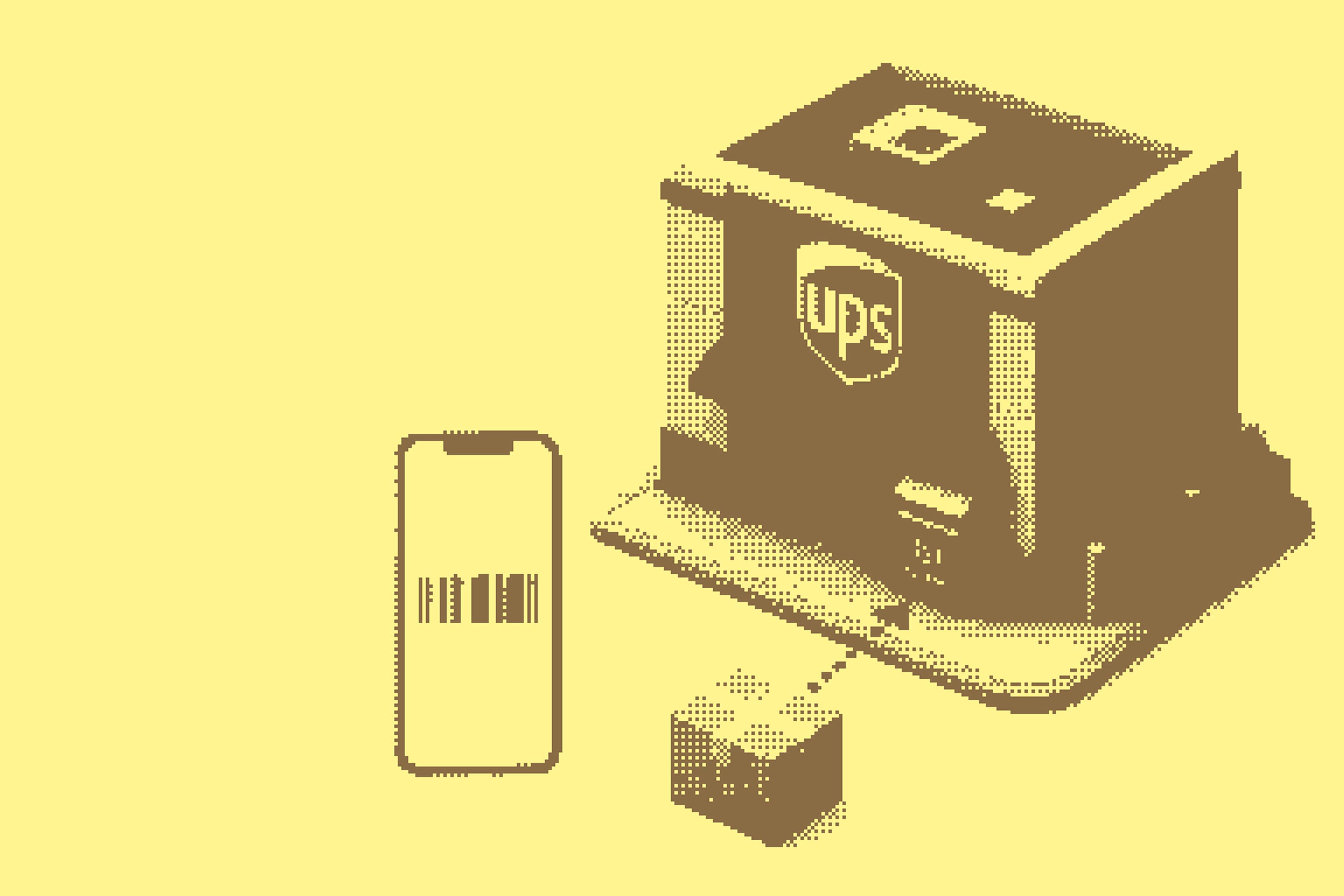
UPS no-label shipping replaces the printed label with a scannable barcode generated at time of purchase.
All shipment data, including tracking number, service level, and routing, transfers intact.
There are 5,000+ UPS Store locations in the U.S. that support barcode drop-off.
What UPS No-Label Shipping Actually Is
It's simple: UPS lets you buy postage and generate a barcode instead of a label. The barcode lives on your phone or mobile device, and it contains all the same data as a physical label: origin, destination, weight, service level, tracking number. Nothing is lost.
When you arrive at any UPS Store location, the clerk scans it, prints the label in-store, and accepts the package. The shipment enters UPS's system the same way it would with any standard drop-off.
The distinction that matters operationally is where the label gets printed. Moving that step to the UPS Store removes the equipment dependency entirely on your end.
For multi-location retail, distributed 3PLs, and brands managing returns across a fragmented footprint, that distinction matters. You're not losing functionality. You're moving it to where it makes operational sense.
Your Workflow, Unchanged
Soapbox now supports UPS no-label shipping natively. The process only differs from standard label generation by one step.
Build the shipment. Enter origin, destination, weight, and service level. Soapbox rate shops the shipment across your full carrier mix in real time.
Pick your preferred service. Ground, expedited, or any service level tier you have with UPS. Soapbox displays the rate and service matched side-by-side.
Choose Mobile Barcode at label generation. Instead of sending a label to your printer queue, Soapbox generates a mobile barcode.
Drop at UPS. Any UPS Store location scans the barcode, prints the label in-store, and the shipment is live in your tracking dashboard and theirs.
Everything else about your operation stays the same. Routing rules still apply. SLAs still govern carrier selection. The only thing that changes is you no longer need a printer at the drop-off point.
Why It Shifts The Economics
Cost containment becomes automatic. No more printer, toner, or label stock purchase. No more IT support tickets when hardware fails at a pop-up location or a store that ships occasionally. Every new fulfillment node you open carries zero incremental equipment cost for this workflow.
You can operate and ship from anywhere. Store associates and customers can drop packages at a UPS Store on the way home. Returns teams work without a back office. The constraint that required a printer at every shipping point is gone.
Carrier visibility stays unified. UPS barcode shipments appear in Soapbox alongside FedEx, USPS, and any other carrier in your mix. Same tracking data, same dashboard, no platform switching. Your ops and customer service teams see a complete picture.
Returns become frictionless. Generate a barcode and send it to the customer. They drop the package at any UPS Store. The return enters your system in real time. No manual exceptions for your team. No confusion for the customer about where to go or what to bring.
Where This Fits in a Distributed Operation
UPS no-label shipping is useful on its own. It's more useful when it's part of a broader approach to distributed fulfillment.
Running operations across multiple nodes, whether those are stores, warehouses, 3PL hubs, or returns desks, requires visibility and routing that can handle handoffs at each location. UPS no-label removes one infrastructure dependency from those handoffs. You don't need to provision hardware at every node.
When you stack this with Soapbox's automated rate shopping, rules-based routing, and order-to-carrier orchestration, you get a UPS workflow that runs from order placement to drop-off without manual intervention. That's the point: less manual work, clearer decisions, faster throughput.
FAQ: UPS No-Label Shipping
What is UPS no-label shipping?
UPS no-label shipping is a method that lets you purchase postage and generate a scannable barcode instead of printing a physical label. You bring the package to any UPS Store, the clerk scans the barcode, prints the label on-site, and accepts the shipment. All tracking and routing data transfers the same way as standard shipping.
How does UPS no-label shipping work at the drop-off location?
When you arrive at a UPS Store, a clerk scans the barcode on your phone or a printed confirmation. The store's system reads the shipment data from the barcode, prints the label in-store, and accepts the package into the UPS network. The shipment enters the carrier system the same way any drop-off does.
Do I need any special equipment for UPS no-label shipping?
No. You need a device that can display the barcode. A smartphone is sufficient. The UPS Store provides the label printer and all consumables. There is no hardware requirement on the shipper's side.
How many UPS Store locations accept no-label shipments?
There are more than 5,000 UPS Store locations in the United States that support barcode drop-off for no-label shipments. Coverage is broad enough to support distributed operations, multi-location retail, and mobile fulfillment teams without access gaps.
Is UPS no-label shipping available in Soapbox?
Yes. Soapbox supports UPS no-label shipping natively. When you rate and select a UPS service in Soapbox, you can choose to generate a mobile barcode along with a printed label. The barcode automatically attaches to the order record and is ready to use.
Can UPS no-label shipping be used for returns?
Yes. You can generate a barcode and share it with the customer. They bring the package to any UPS Store, where the clerk scans the barcode and accepts the return. The return enters your system in real time, with no manual processing required on your end.
FedEx QR Code shipping is free and available on all U.S. domestic FedEx services
Accepted at FedEx Office, FedEx Ship Center, and participating Walgreens locations (10,000+ total)
Generate the QR code in Soapbox, drop the package, and staff handle the rest
Every QR shipment tracks end-to-end inside your Soapbox dashboard
Over 2,000 FedEx Office® locations accept box- and label-free returns for seamless drop-offs
Box and label-free returns
Printer Dependency Is a Fulfillment Problem
Why Printer Dependency Is a Fulfillment Problem
Most ops teams don't budget for printer failure. They should.
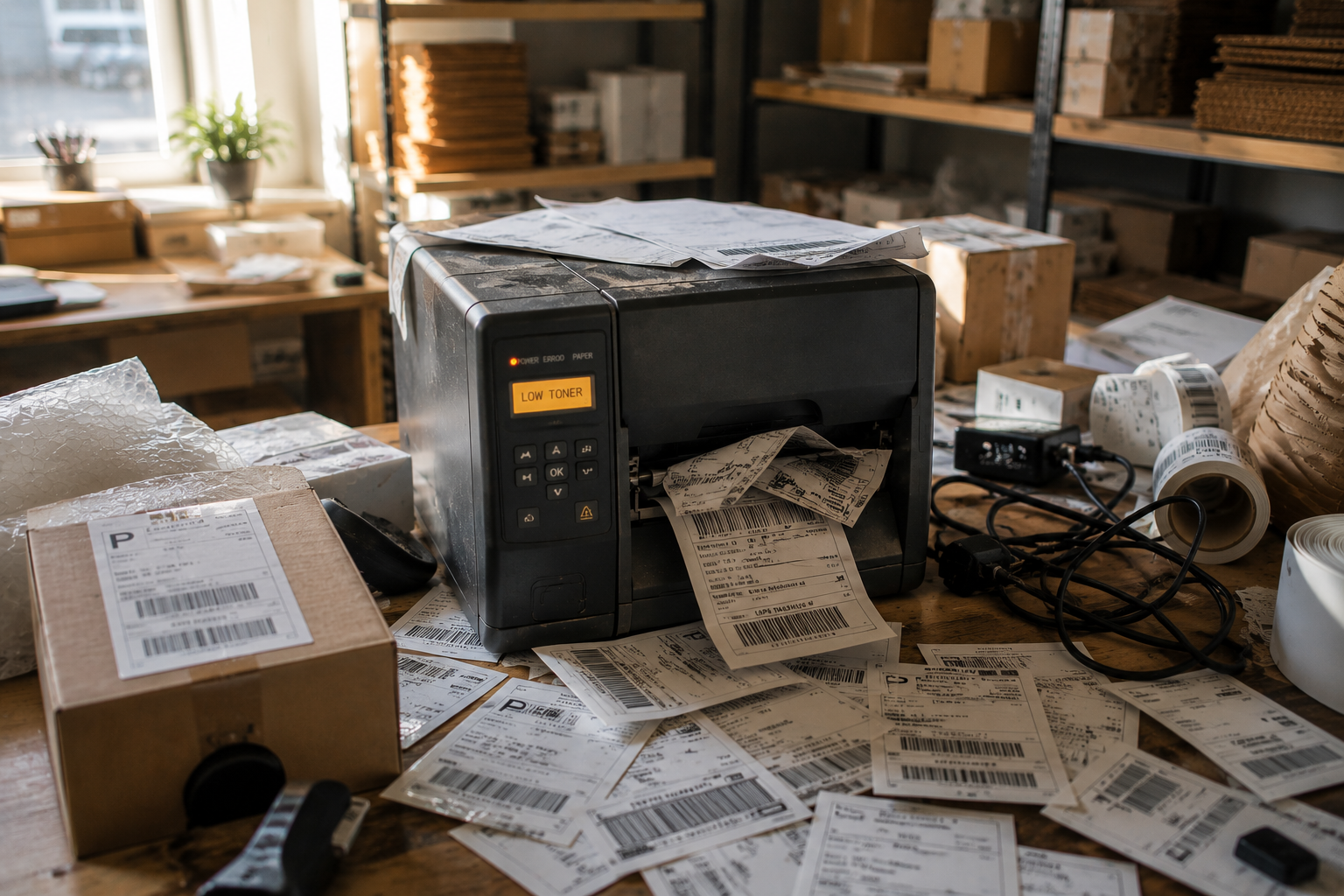
Toner runs out mid-shift. Label stock gets depleted on a Friday. A new store location needs a printer before it can ship a single package. A mobile returns team can't ship without a workstation. These aren't edge cases. They're recurring costs that slow throughput, delay shipments, and compound across every node you operate.
Hardware scales linearly with your network. Every new fulfillment point, pop-up, or returns counter you add creates another equipment dependency. That's capital tied up in infrastructure that exists solely to print a 4x6 sticker.
FedEx QR Code shipping removes that dependency at the point of fulfillment. You generate the code. FedEx locations handle the printing. Your team moves on with their day.
What Is FedEx QR Code Shipping?
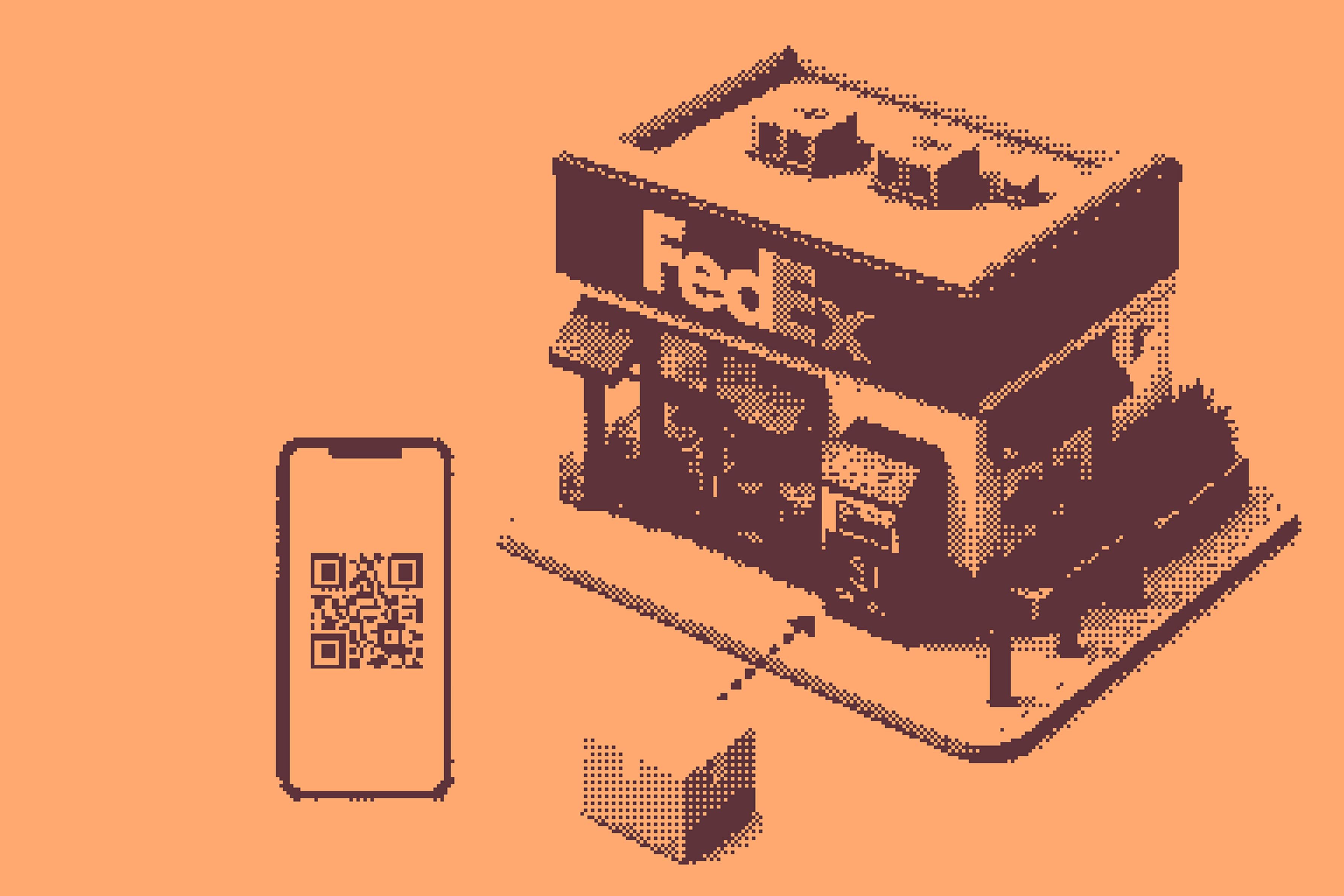
FedEx QR Code shipping is a label-free option that replaces the printed label with a scannable code generated at shipment creation. You bring the package and the code to a FedEx QR-enabled location. A staff member scans it, prints the label, and accepts the shipment.
Accepted locations include:
FedEx Office locations nationwide
FedEx Ship Center locations
Participating Walgreens locations
Total coverage: 10,000+ drop-off points across the U.S. The service carries no additional fee and is available across all FedEx U.S. domestic shipping services.
For teams running distributed fulfillment, this matters because the drop-off network is already built. For brands, you're reducing the friction of returns for your customers. You're not asking staff or customers to find a specialty location. You're sending them somewhere they already know.
How FedEx QR Code Shipping Works in Soapbox
The workflow fits into your existing fulfillment process without rebuilding it. Here's how it runs:
1. Create the shipment in Soapbox. Enter your ship-from, ship-to, weight, and dimensions the same way you would for any carrier. Nothing changes upstream.
2. Select FedEx and choose your service. Soapbox surfaces rate options across FedEx domestic services. Filter by SLA, cost, or delivery window.
3. Choose QR Code at label generation. Instead of sending a label to your printer queue, Soapbox generates a QR code.
4. Drop off at a FedEx QR-enabled location. Staff scan the code, print the label, and accept the package. The shipment appears in your Soapbox tracking dashboard from that point forward.
That's the full flow. No new hardware. No integration changes. No separate carrier portal.
How a Peer-to-Peer Rental Company Stopped Losing Shipments to Printer Problems
One Soapbox customer runs a peer-to-peer rental marketplace. Lenders ship items to renters, renters ship them back. The model depends on both sides of that transaction completing reliably.
The problem: lenders aren't warehouse operators. Most don't own label printers. When a rental was booked, lenders had to find a way to print a label before they could ship. Some asked a neighbor or family member for help. Some just didn't ship on time. Every delayed shipment created a customer service issue on the renter side and a trust problem for the platform.
Returns were worse. Renters returning items faced the same friction in reverse, with a tighter deadline.
After enabling FedEx QR Code shipping through Soapbox, the workflow changed entirely. When a rental is booked, the platform generates a QR code through Soapbox and sends it directly to the lender. The lender walks the item into any FedEx Office or participating Walgreens, shows the code, and hands off the package. Same process on return for the renter.
No printer required on either side of the transaction. Fewer delayed shipments. Fewer CX tickets. And because every shipment flows through Soapbox, the ops team has end-to-end visibility across all lender and renter activity in one place, without chasing tracking numbers across separate carrier portals.
It's a clean example of what printer-free shipping unlocks for non-traditional fulfillment models. When your shippers aren't ops professionals, removing hardware requirements isn't a convenience feature. It's a reliability feature.
Operational Use Cases Worth Knowing
The rental example illustrates a broader pattern. Printer-free shipping solves a real problem any time your shippers aren't warehouse staff.
Retail store fulfillment. Store associates handling ship-from-store orders don't need dedicated label printers at every register or back-of-house station. One drop per day.
Mobile and pop-up operations. Events, pop-ups, and seasonal locations are hard to equip with full label printing infrastructure. QR codes make them functional shipping nodes from day one.
Returns counters. Customers bringing back items can use a QR code generated in your returns flow. No box required at 2,000+ FedEx Office locations. That's a meaningful reduction in friction at the point of return, and it takes work off your CX team.
New location onboarding. Opening a new warehouse or DC doesn't have to wait on printer procurement. FedEx QR Code shipping lets that location start shipping while the hardware order is still in transit.
Visibility Doesn't Change
One concern ops teams raise: does a QR-based shipment track the same way as a standard label?
Yes. Every FedEx QR shipment created through Soapbox appears in your tracking dashboard with the same end-to-end visibility you'd get from a printed label. Scan events, transit updates, and delivery confirmation all flow through. Nothing changes from a data standpoint.
If you're running batched shipments or routing across multiple carriers, QR-based FedEx shipments slot into the same pipeline. Standardized data. One view. No reconciliation across separate portals.
Frequently Asked Questions
What is FedEx QR Code shipping?
FedEx QR Code shipping is a label-free drop-off option. Instead of printing a label, you generate a QR code at shipment creation. A staff member at a FedEx-enabled location scans the code and prints the label on your behalf. There is no cost for the service, and it works across all FedEx U.S. domestic shipping options.
Which FedEx locations accept QR Code shipping?
QR codes are accepted at FedEx Office, FedEx Ship Center, and participating Walgreens locations. That covers more than 10,000 drop-off points across the U.S. You can confirm specific locations using the FedEx location finder tool.
Which FedEx services are eligible for QR Code shipping?
All FedEx U.S. domestic services are eligible when shipping through Soapbox. You select your service at rate shopping, then choose QR Code at label generation.
How does FedEx QR Code shipping work for returns?
For returns, customers bring the item and a QR code to a FedEx location. No box and no printed label are required at over 2,000 FedEx Office locations. The QR code is generated in your returns flow and sent directly to the customer.
Does a QR-based shipment track the same way as a printed label?
Yes. FedEx QR shipments created in Soapbox track with full end-to-end visibility, including scan events, transit updates, and delivery confirmation. All data surfaces in your Soapbox dashboard the same way as any printed label shipment.
Is there a fee for FedEx QR Code shipping in Soapbox?
No. FedEx QR Code shipping carries no service fee. You pay the standard rate for the FedEx service you select. The QR code option is just the label generation method.
FedEx QR Code Shipping Is Live. Start Using It.
If your team ships FedEx and you have locations without printers, or locations where printer dependency is slowing you down, QR Code shipping is available in your Soapbox account today.
Log in, create a shipment, and choose QR Code at label generation.
For more than a century, people who wanted to be heard stood on soapboxes.
Literally.
In the late 1800s, wooden crates used to ship soap were common, sturdy, and everywhere. Turn one upside down, step up, and suddenly your voice carried farther. The crowd could see you. Your ideas had a place to stand.
Over time, "getting on your soapbox" came to mean speaking clearly about something that matters, with the confidence that what you had to say deserved to be heard.
It started as a supply chain artifact. It became a symbol of clarity.
The Origin Is Oddly Fitting
Soapboxes began as simple shipping containers, moving products through warehouses, rail yards, and storefronts. Long before they became a stage for public speeches, they were part of the logistics system that kept goods flowing.
We named this platform Soapbox for exactly that reason. The word lives at the intersection of physical logistics and the act of speaking clearly. That is not a coincidence. That is the whole idea.
Modern supply chains are far more advanced than wooden crates. But they face a strikingly similar challenge: the signal is there, it just has nowhere clear to stand.
Operations data lives in too many places. Orders in one system, inventory in another, shipping somewhere else, reporting stitched together afterward. The result is plenty of activity, but not always enough clarity.
According to McKinsey's 2025 Supply Chain Risk Pulse survey of 100 global supply chain leaders, 95% of companies have visibility into their tier-one supplier risks, but that visibility extends to tier two or beyond for only 42% of them.
The signal exists. It just has no clear place to stand.
What Soapbox Actually Does
Soapbox is a platform built for operations teams who need to manage orders, track inventory, coordinate warehouse activity, and orchestrate shipping, without toggling between five different tools to do it.
The environment makes this more urgent than ever. That same McKinsey survey found that the share of companies planning major digital supply chain investments has dropped from 47% to 25% in a single year, as teams get pulled toward tactical firefighting instead of structural improvement. Soapbox exists for exactly that tension.
The companies using Soapbox today range from high-growth ecommerce brands like Knockaround to established CPG and retail operators like Dairy Farmers of America. What they share is a need for operational clarity. They need to know what is coming in, what is going out, where things are, and what needs attention right now.
Orders flow from storefronts and ERPs into a shared operational view. Inventory stays visible across warehouses. Fulfillment and shipping decisions can be made with the full picture in mind.
Soapbox connects those data points across systems so that operations leaders can make better decisions, faster. Not by replacing every tool they already use, but by giving those tools a shared stage.
***
"Everyone is asking how AI will transform supply chain. The more important question is what AI will have to work with. Right now, most supply chains are too fragmented to support the decisions humans are already trying to make, let alone autonomous systems. Soapbox is solving that layer first. Unified, real-time operational data is not a nice-to-have. It is the infrastructure everything else gets built on."
Laura Lakhwara, VP of Growth, Soapbox
***
Put It on Soapbox
Your supply chain has something to say. The data is there. The signal is real. It just needs somewhere to stand.
That is the idea behind the campaign we are building around our new home at onsoapbox.com.
OMS on Soapbox.
WMS on Soapbox.
TMS on Soapbox.
Your orders on Soapbox.
Your shipments on Soapbox.
Your supply chain on Soapbox.
The platform does not need to own every system. It needs to connect them. When that connection exists, teams spend less time reconciling data and more time running the business.
That is what the original soapbox did, too. It did not create the voice. It just gave it somewhere to stand.
The companies that win the next decade of supply chain will not be the ones with the most tools. They will be the ones with the clearest picture.
Started in March 2025, Basic 3PL’s goal is to address the need for high-velocity fulfillment by providing lower overhead costs, faster delivery, and zero friction.
Technology Built for High-Velocity Fulfillment
At the core of Basic 3PL’s technology and performance is its integration with Soapbox, powering advanced OMS (Order Management System) capabilities. The company’s operations are built around the speed and fluidity of the facility and fulfillment flow, supported by automation designed to deliver excellent service quality. Basic 3PL positions its automation as reducing human error across the fulfillment lifecycle by minimizing manual touchpoints wherever automation is deployed, citing a 0.001% error rate in its pick-and-pack service as one benchmark of that accuracy.
Designed for Peak Scale and Performance
Basic 3PL is also designed for significant peak capacity, with up to 1 million orders per day during peak season, supporting brands that need rapid scale without compromising operational velocity.
Cost Efficiency Through Free Trade Zone Replenishment
A strategic competitive edge is Basic 3PL’s “Free Trade Zone Replenishment” model, in which inventory is stored without incurring taxes or tariffs until the moment it is shipped. Basic 3PL cites aggressive cost savings of up to 20% to 40% compared to traditional 3PLs, driven by cutting labor costs through automation.
Global Reach With a U.S. Home Base
Basic 3PL is built to support brands globally and domestically. The company has consolidation centers overseas and maintains a presence across seven different countries, enabling broader reach while keeping a U.S. home base for brands.
Commitment to Workforce Elevation and Sustainability
Basic 3PL is committed to social responsibility and local economic impact, emphasizing that automation is meant to elevate roles, not eliminate them. Helping to shift positions into higher-quality, stable, and more skilled opportunities within the region. From a sustainability perspective, the company highlights packaging optimization that reduces waste by weighing and measuring each product and tailoring packaging to fit more precisely.
“BASIC 3PL is unique. Most supply chain companies sell either labor, software, freight, or robots. We are the only provider delivering all of it through one unified platform,”
said Jing Jing Chen, VP of Growth.
About Basic 3PL
Basic 3PL is a U.S.-owned fulfillment partner built to solve modern supply chain challenges by enabling high-velocity distribution into the American market. Launched in March 2025, the company helps brands, from the U.S. and around the world, scale their U.S. operations quickly through lower overhead, faster delivery, and a low-friction fulfillment experience. Powered by Soapbox, Basic 3PL delivers advanced OMS capabilities and an operation designed for speed, automation-driven service quality, and peak-season volume. With a global footprint that includes overseas consolidation centers and presence across seven countries, Basic 3PL provides an efficient U.S. home base for brands fulfilling orders to American consumers.
Over the last few years, Soapbox has evolved from a set of powerful capabilities into an orchestration platform for modern supply chains. Our new brand and website reflect that shift: more clarity and intention and a stronger sense of the role we play at the center of complex operations.
Supply Chains Have Changed
Brands now operate across more channels, more partners, more warehouses, and more systems than ever before. What once worked as disconnected tools now requires coordination at the system level.
Soapbox was built for that reality.
We unify order, inventory, and shipping data, enforce operational rules, and maintain a reliable source of truth across the network. Instead of stitching together point solutions, teams use Soapbox to run their operations as a system.
The refreshed brand brings focus to what Soapbox is today: an orchestration layer for real operations, real people, and real accountability.
The Meaning Behind the New Logo
The refresh begins with a single idea: end-to-end orchestration.
That idea is expressed most clearly in our new logo. The double box represents two levels of connection – between tools and people and between logic and execution – while forming a simple monogram “S.”
It reflects how Soapbox brings systems and teams into one coordinated flow: orders and inventory, software and operators, decisions and action. Like the platform, the mark is designed to hold complexity while presenting clarity.
One Platform, Working Together
Soapbox brings order management, inventory management, shipping, and integrations into a single orchestrated platform. Each capability strengthens the others. Decisions are made with full context. Data flows without manual reconciliation.
The result is less operational drag and more control as complexity grows.
This platform has been shaped alongside customers who needed more than tools. They needed infrastructure for how their business actually runs.
A System Built for Movement
Orange has been a part of Soapbox since the beginning. It remains our anchor color, signaling warmth, utility, and motion.
The updated visual system builds on that foundation. It’s designed to feel active but controlled, modern yet grounded. Every element serves a purpose. Just like the platform itself.
From the Founder
Soapbox has grown — and so has the trust behind it.
We’re no longer just connecting systems; we’re helping teams run their business every day.
This refresh keeps things simple, steady, and built for how supply chains really work.
Change isn’t slowing down, but we’re here to help you keep control.
Glad you’re here.
Danny He, Founder & CEO, Soapbox
---
Built in partnership with Jekyll Studio, whose thoughtful approach to brand and systems design helped translate the Soapbox vision.
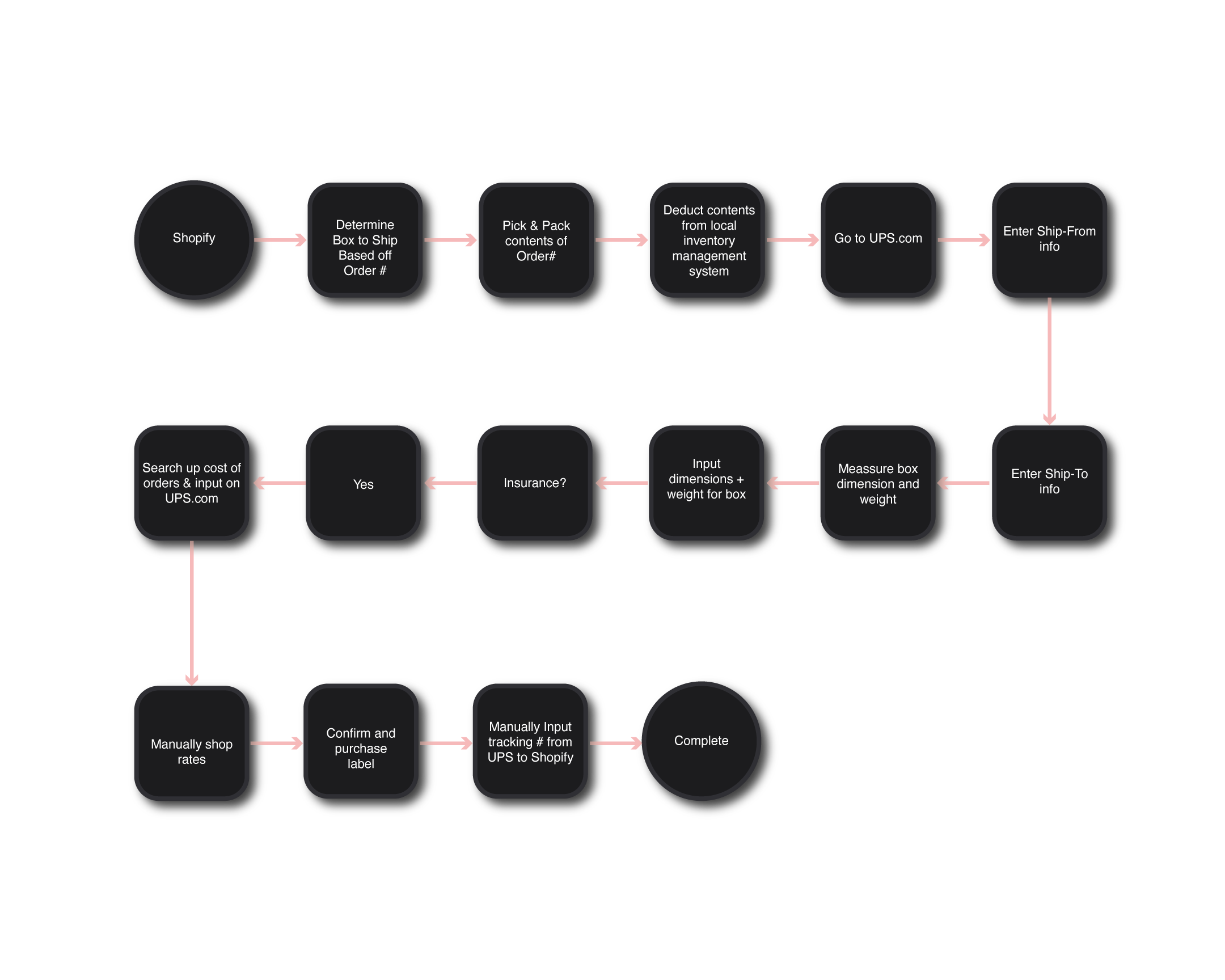
When U-Best began handling fulfillment for Dave’s Hot Chicken, the growth was exciting but the process behind the scenes can be a bit chaotic.
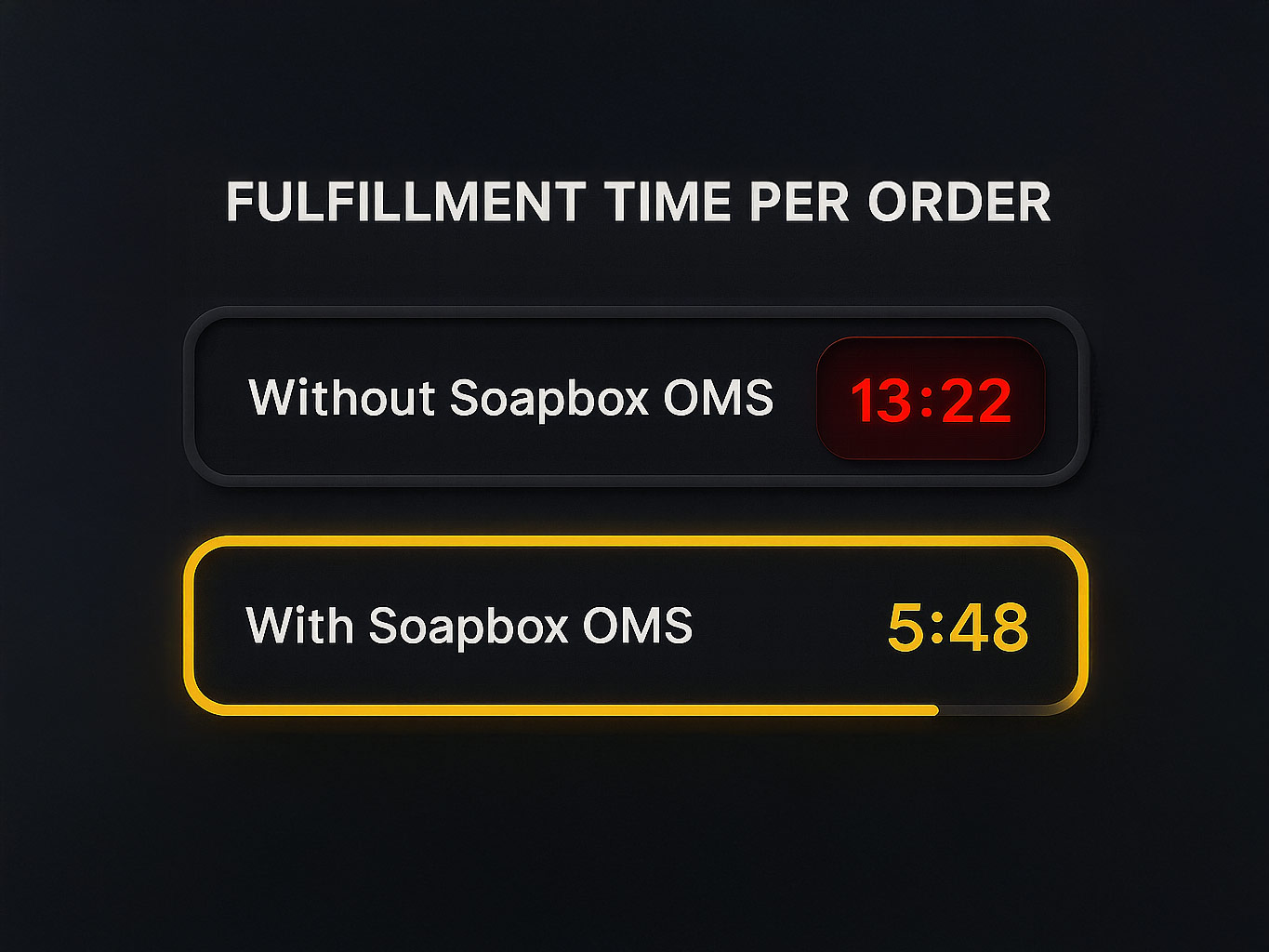
Their post-order flow was a 16-step patchwork that leaned heavily on copy-paste workarounds just to keep orders moving. On average, it took 13 minutes and 22 seconds to fulfill a single order; every step introducing risk, delay, and cost.
The problem was this; their systems, Shopify, Odoo, and UPS, weren’t connected. They worked fine on their own, but there was no shared data. Operators had to bridge the gaps manually, re-enter information across platforms and chase down updates.
What We Stepped Into
U-Best needed a faster, cleaner way to move orders from Shopify to Odoo and out the door with UPS, without adding to their workflows or adding more people.
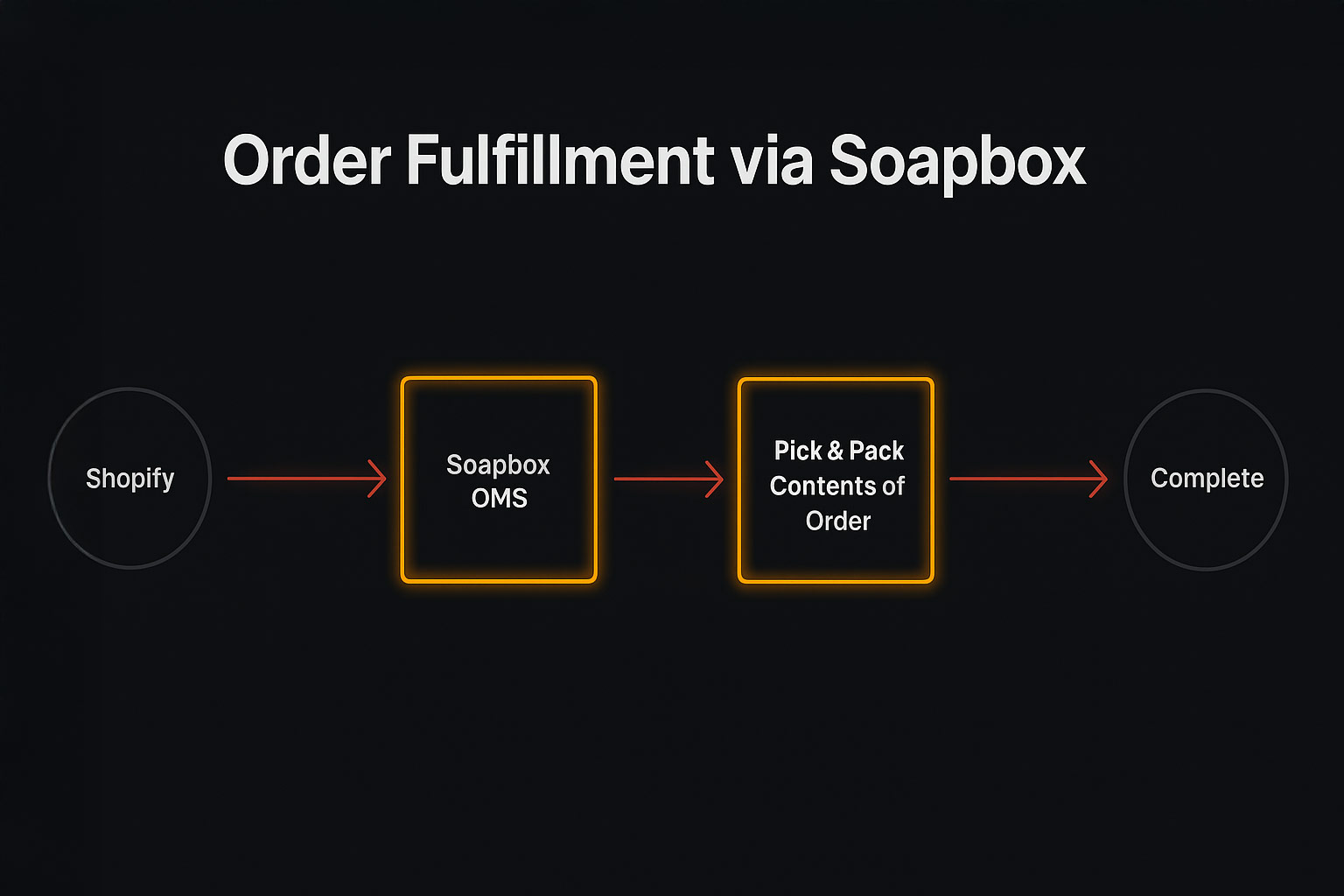
Soapbox integrated between their systems and took over the orchestration layer:
Orders from Shopify flow directly into Soapbox via real-time API
Soapbox generates the shipment, deducts inventory, and creates the UPS label
The tracking info gets posted back to Shopify automatically
Instead of 16 fragmented steps, fulfillment became a unified, 4-step process. No more bottlenecks. No more double entry.
The Before and After
Fulfillment time dropped 57% From 13m 22s → 5m 48s per order
Manual steps reduced from 11 to 4 Operators can now process 2.3x more orders per shift—with the same team.
Fulfillment Time Per Order
Scalable fulfillment, without the growing pains. These gains flowed directly to Dave’s Hot Chicken, too—since U-Best acts as a 4PL for the brand.
Why It Worked
This wasn’t a full system overhaul. It was smart orchestration between systems they already used, built to scale with demand instead of stall it.
That’s the power of clean integrations and a real OMS engine in the middle.
Takeaway
If fulfillment still feels like a workaround, not a workflow, it might be time to reassess how your systems are actually supporting growth.
At Soapbox, we help brands and 3PLs simplify the complex, unify their tech stack, and get orders out faster. This is what that looks like in action. (Do we have a demo video to support this statement?)
The second half of the year doesn’t give you time to catch your breath.
For fast-growing brands, Q3 is the pressure test: demand ramps up, order volumes spike, and minor operational inefficiencies quickly become revenue leaks. If your systems aren’t ready, Q3 doesn’t just expose your supply chain problems, it amplifies them.
Let’s be direct: scaling without the right infrastructure is a liability.
The Real Cost of Manual Ops in a High-Volume Quarter
In 2025, many teams are still stitching together spreadsheets, emails, and disconnected systems to manage their supply chain fulfillment. In Q3, that’s no longer sustainable especially if you want a successful Q4.
If you're still running manual or semi-manual ops, here’s what your day-to-day reality might look like:
Late or missed orders due to poor inventory visibility
Support tickets piling up from confused customers
Operators manually routing shipments in real time
Headcount stretched beyond capacity
Sales teams pulling back to avoid overpromising
The worst part is that these issues rarely show up on a dashboard until it's too late. By then, your brand failed to meet its promise to your customers, leaving them looking elsewhere.
What High-Performing Teams Are Doing Instead
Top operators aren’t adding more tools to their tool kit; they’re building smarter infrastructure that scales with them.
Here’s what that looks like for them:
Connected: Real-time data sync across OMS, WMS, 3PLs, and eComm tools
Automated: Manual updates replaced with event-based triggers and intelligent workflows
Visible: Inventory, order, and fulfillment data is accessible and actionable
Proactive: Bottlenecks are flagged and resolved before customer impact
This kind of operational clarity gives teams room to breathe even when volume surges.
Real Case Impact: How De‑Fi Rebuilt Their Ops Ahead of a Volume Spike
Take one of our clients, De‑Fi, a premium audio equipment brand.
When pandemic-era demand sent orders soaring, their back end couldn’t keep up. Inventory was tracked on spreadsheets. Fulfillment was reactive. Stockouts and shipping delays became a frequent challenge and they lacked real-time visibility to respond quickly.
Then wildfires hit Los Angeles. De‑Fi’s founder lost his home, and the team had to run operations remotely overnight.
De‑Fi reached out to Soapbox to rebuild their operations with Soapbox’s fully integrated infrastructure. Soon,
Orders were automatically routed and fulfilled faster
Inventory synced in real time across channels
Warehouse transitions were executed without disruption
Their ops team gained remote access and forecasting tools
“Soapbox knows our business like it’s their own. That’s rare and invaluable.”
— De‑Fi Operations Manager
De‑Fi didn’t just survive a volatile period, but they also built a scalable foundation that turned uncertainty into opportunity.
Why This Quarter Matters More Than You Think
According to McKinsey, 60% of supply chain leaders cite lack of visibility as their #1 challenge heading into peak season.
And a Gartner study found that over 70% of Q3 disruptions could have been avoided with better system integration and forecasting.
In contrast, brands that invest early in connected systems see measurable results:
41%
faster fulfillment times
37%
fewer stockout
25%
increase in on-time delivery
Q3 isn’t the time to scramble. It’s the time to execute with what you’ve already built.
What to Do Now (Before It’s Too Late)
Let’s examine your situation. If you’re:
Launching new SKUs
Expanding to new channels or markets
Relying on 3PLs or marketplaces for fulfillment
Still managing critical flows in spreadsheets or email,
Then it’s time to ask the tough question:
“Do I have the visibility , data and control to scale for the next 90 days?”
If not, don’t wait for Q3 bottlenecks, or worse, customer churn, before addressing these issues.
Final Word
The companies that win Q4, start now, but also won’t be the ones that push harder.
They’ll be the ones that build a smarter foundation.
Don’t wait for Q3 to come to an end and let operational cracks become customer losses. Build the infrastructure that lets your team move faster, act smarter, and scale stronger.
Because in the supply chain world, Q4 is already in motion.
“Our company is small, so we don’t need supply chain software.”
The Hidden Costs of Manual Supply Chain Management
Lost hours chasing orders and tracking down fulfillment updates
Inventory blind spots that cause stockouts or overstocks
Missed delivery promises that damage your brand reputation
Burnout on your operations team struggling to keep up
These are not just growing pains. They are costly inefficiencies that directly impact your bottom line.
Why Online Sales Storefronts Are Not Enough
Shopify, Amazon, Etsy, TikTok Shops, and similar online storefront platforms excel at managing your digital storefront and processing orders. However, they do not provide full visibility or control over complex supply chains, especially if you:
Work with multiple warehouses or third-party logistics partners
Manage inventory across various sales channels and locations
Need real-time status updates on orders and shipments
Require automated workflows to reduce errors and manual work
Without a dedicated supply chain platform, your data remains siloed, your processes remain manual, and your team remains stuck in reactive mode.
How Soapbox Connects and Automates Your Supply Chain
You do not need to rip and replace your existing ecommerce or warehouse tools. Soapbox is designed to integrate seamlessly with platforms like Shopify, Amazon, Etsy, and TikTok Shops, as well as your warehouse management systems and 3PL partners. We unify your data to give you one source of truth without disrupting your current operations.
With Soapbox, you get:
Connected Data: All your systems talking to each other in real time
Real-Time Visibility: Know exactly where orders and inventory stand at every step
Automation: Replace manual emails, spreadsheets, and updates with automated alerts and workflows
Scalability: Grow confidently without breaking your operations or disappointing customers
Real Business Benefits of Supply Chain Automation
Brands that adopt connected supply chain platforms like Soapbox experience:
Reduced order processing time by up to 40%
Improved on-time delivery rates
Significant reduction in manual errors and costly stockouts
Faster new product launches and market responsiveness
As Danny He, CEO of Soapbox, says,
“You don’t need to replace your stack. You need to connect it, and make it work smarter.”
The Bottom Line
The question is not when to adopt supply chain software. It is how long you can afford to wait before manual processes start to hurt your growth.
Frequently Asked Questions
Do I really need supply chain software if I already have Shopify, Amazon, or TikTok Shops?
Yes. These platforms manage your online storefront and order capture but do not provide end-to-end supply chain visibility or automation needed to scale efficiently.
What problems does supply chain software solve that ecommerce tools do not?
Supply chain software connects data across multiple systems and partners, provides real-time order and inventory visibility, and automates manual handoffs to reduce errors and delays.
How does supply chain automation improve order fulfillment?
Automation reduces time spent on manual tasks, improves accuracy, and allows your team to focus on strategic growth instead of firefighting daily operational issues.
Ready to scale your supply chain with confidence?
Contact Soapbox today for a personalized demo and see how connected operations can transform your business.
In supply chain management, speed, accuracy, and visibility aren’t just nice to have; they’re non-negotiable. And yet, even the most forward-thinking enterprises find themselves slowed down by the very systems meant to streamline operations.
Here’s the reality: if your Order Management System (OMS) and Warehouse Management System (WMS) aren’t fully integrated, your fulfillment operations are likely under strain.
Let’s take a closer look at the signals.
1. You’re Missing SLAs, But the Underlying Problem Is Unclear
If you’re seeing late deliveries, delayed shipments, or incomplete orders, you're probably missing critical SLAs. But identifying why is a whole other challenge.
The culprit is often system silos.
When your OMS and WMS aren’t aligned, tracing the origin of an issue becomes a guessing game. Was it a picking delay? Out-of-stock inventory? A handoff breakdown?
Without real-time order visibility and synchronized data across systems, you’re operating with guesswork.
2. Your Team Is Plugging Gaps with Manual Workarounds
Manual order updates. Spreadsheet reconciliations. Phone calls between teams to verify stock or reroute fulfillment. Do any of these sound familiar?
These band-aid fixes are common but costly not just in time, but in inventory accuracy, labor costs, and scalability.
When systems don’t talk, human workarounds become the default. And every manual process introduces risk.
If your fulfillment team spends more time correcting mistakes than optimizing workflows, that’s a sign your supply chain tech stack isn’t unified and your WMS and OMS are speaking different languages.
3. Scaling Creates Complexity, Not Simplicity
Expanding your operation, whether it’s adding a warehouse, launching new SKUs, or entering new markets, should feel like growth, not chaos.
But, for many businesses, each layer of expansion introduces more workflows, more training, and more room for error.
That’s not sustainable.
Scalable supply chains are built on streamlined, standardized systems.
Without unified order, inventory, and fulfillment visibility, growth becomes a liability instead of a strength.
Can you trace an order’s lifecycle, including bottlenecks and exceptions without jumping between systems?
If the answer is “not really,” you’re not alone. Most companies have inherited systems that were never built to scale together.
But the longer you delay, the more these issues will cost you in margins, customer experience, and agility.
A Unified Supply Chain Tech Stack Isn’t a Luxury. It’s a Competitive Advantage
At Soapbox, we help enterprise brands and 3PLs eliminate blind spots and reduce order errors by unifying OMS, WMS, and inventory data into a single, real-time platform.
Our clients don’t just move faster, they move smarter, with the confidence that their data is connected, clean, and actionable.
Even if you’re not ready to overhaul your systems yet, start with this: Standardize how your systems communicate.
Because if your data is fragmented, your supply chain will be too.



.png)